How Small and Mid-Size Companies Can Achieve Growth While Improving Return on Invested Capital
Most SMIDs pursue growth or efficiency—the highest-performing companies pursue both simultaneously. Here's how to build the dual engine that delivers revenue growth and ROIC improvement.
By Gregg Carlson Empower Your Business Today February 26, 2026 8 min read
Small and mid-size companies face a paradox: growth consumes capital even as shareholders demand improving returns on it. Resolving this tension—not just managing it—is the defining challenge of SMID leadership.
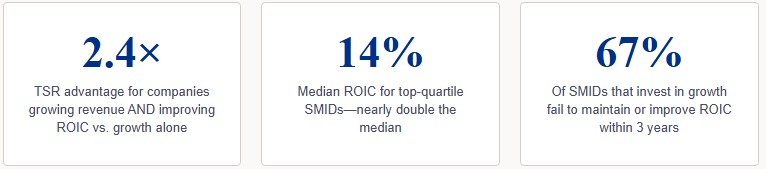
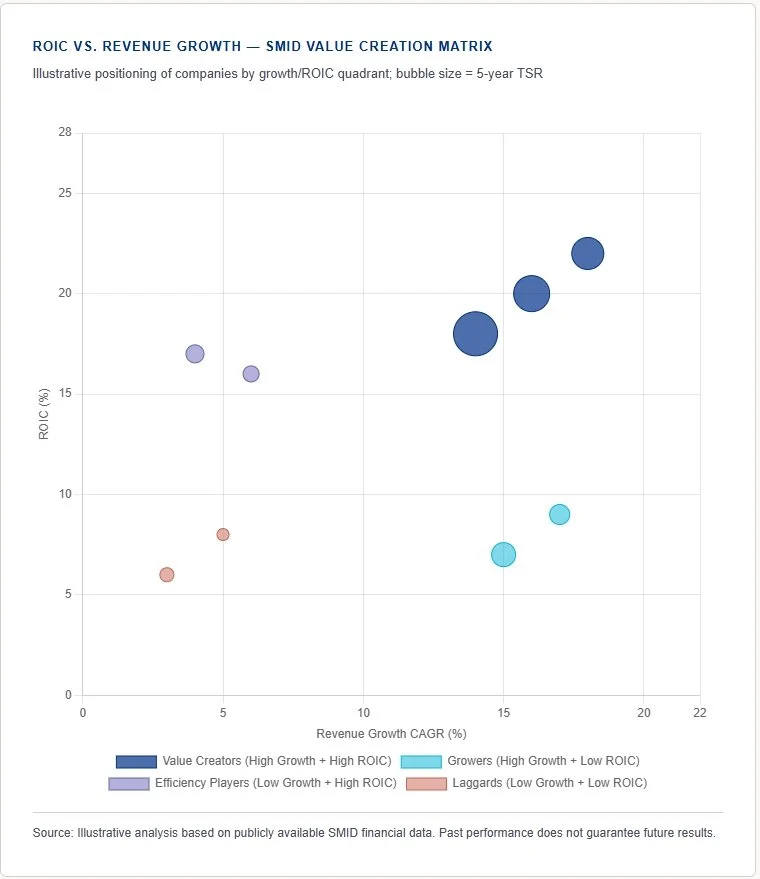
For most small and mid-size companies (SMIDs), the strategic conversation tends to collapse into a binary: grow fast and accept thin returns, or tighten operations and accept slow growth. Both postures are traps. Research across high-performing SMIDs consistently shows that companies generating superior shareholder value over a 10-year horizon are those that grow revenues meaningfully while simultaneously improving ROIC—not sequentially, but together.
The question is not whether to pursue both. The question is how to build the organizational and financial architecture to do it.
Why ROIC Is the Right North Star for Small and Mid-Size Companies
Earnings growth is seductive but incomplete. A company can grow earnings by deploying more capital—but if that capital earns less than its cost, value is destroyed, not created. ROIC (Return on Invested Capital) captures what earnings alone cannot: whether the business creates economic profit.
For SMIDs specifically, ROIC disciplines the instinct to grow for growth's sake. It forces leadership teams to ask not just "what can we do?" but "what should we fund—and what should we exit?" This question, asked consistently, is the foundation of durable competitive advantage.
Key Principle
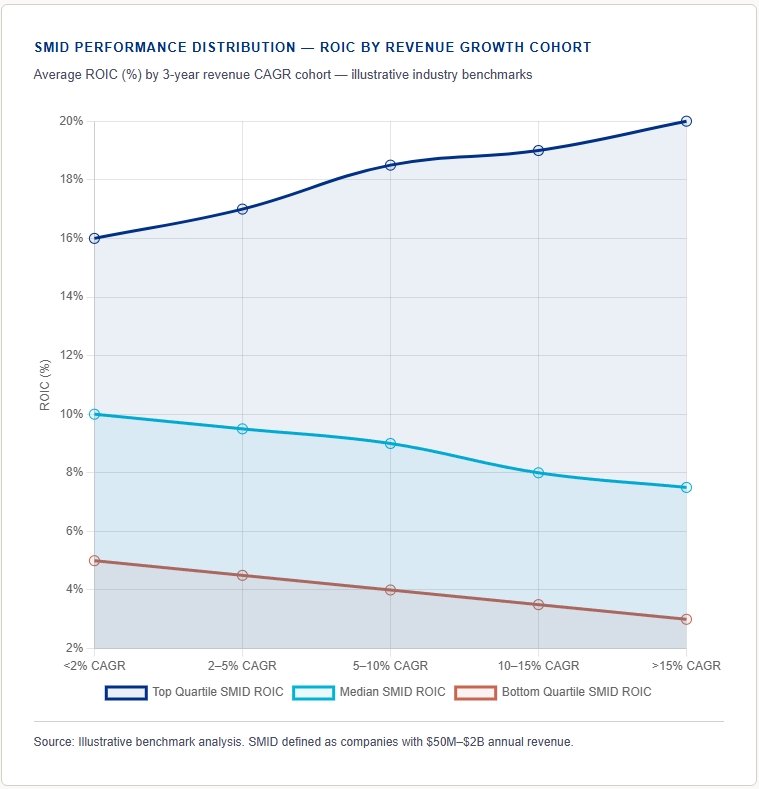
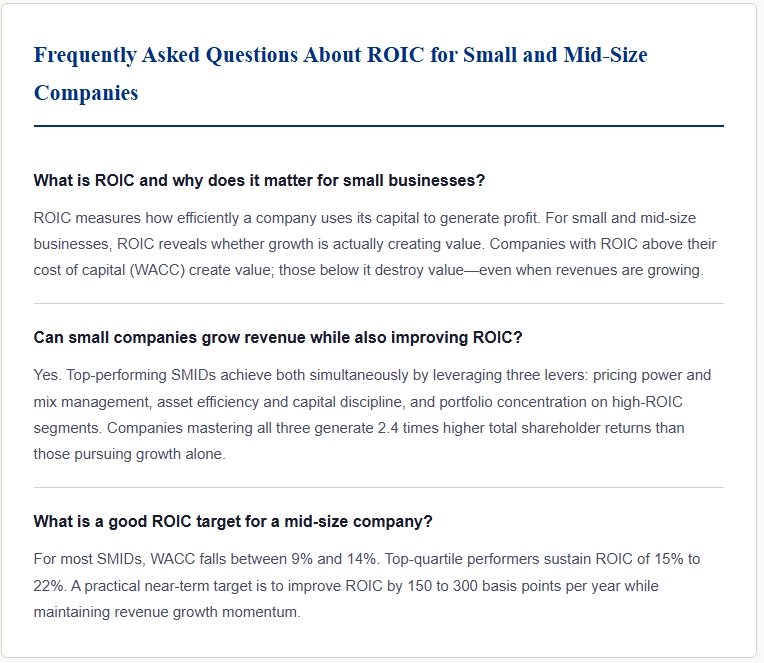
Companies with ROIC consistently above their weighted average cost of capital (WACC) create value with every incremental dollar deployed. Those below WACC destroy value—even when growing. For SMIDs, WACC typically ranges from 9% to 14%; the best performers sustain ROIC of 15% to 22%.
The Three Levers That Move Both Needles: Growth and ROIC Simultaneously
The highest-performing SMIDs don't treat growth and ROIC as separate workstreams. They operate three levers that, when pulled in concert, advance both metrics simultaneously.
Lever 1: Pricing Power and Revenue Mix Management
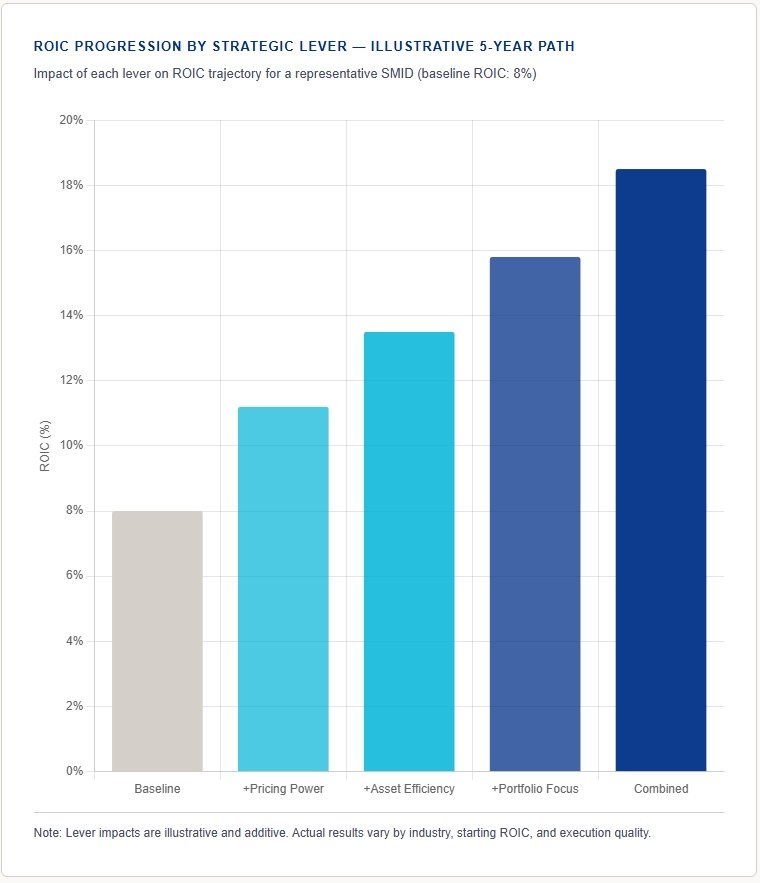
Pricing is the single highest-ROIC growth lever available to small and mid-size businesses. Unlike volume growth, which consumes working capital and fixed cost overhead, price improvement falls almost entirely to the bottom line. SMIDs that invest in understanding customer value drivers—and in building the pricing discipline to capture it—routinely see 200–400 basis point ROIC improvements within 18 months without incremental capital investment.
Mix management is the companion discipline: systematically shifting revenue toward higher-margin customers, products, and channels. This often requires the courage to exit relationships that feel like revenue but are, in ROIC terms, value-destroying.
Lever 2: Asset Efficiency and Capital Discipline
ROIC = NOPAT ÷ Invested Capital. Most SMID leaders focus on the numerator (profit). The denominator (capital) is equally powerful. Reducing the capital required to run the business—through working capital optimization, asset-light business model adjustments, or disciplined capex prioritization—improves ROIC even when profitability is flat.
Lever 3: Portfolio Concentration on High-ROIC Segments
Diversified SMIDs almost universally underperform focused ones. Capital and management attention spread across too many markets, products, or customer segments produces mediocre ROIC everywhere. The discipline of concentrating resources in the segments with the highest ROIC potential—and exiting the rest—is counterintuitive but reliably value-creating.
Building the Dual-Engine Architecture for Sustained ROIC and Growth
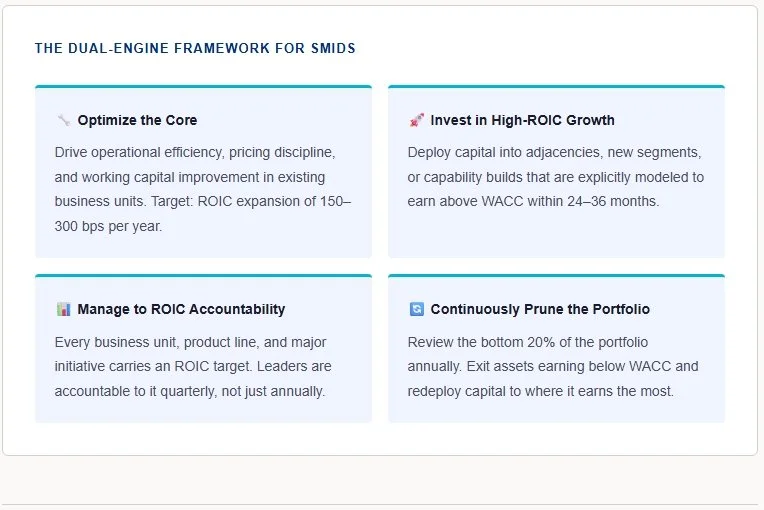
The companies that sustain both growth and ROIC improvement share a structural characteristic: they separate the operating engine (running today's business at peak efficiency) from the growth engine (investing in tomorrow's revenue), and they resource each appropriately.
Common ROIC Pitfalls for SMIDs—and How to Avoid Them
The Growth Trap: Chasing revenue without modeling ROIC impact. Every major growth initiative should include a pro forma ROIC bridge showing how and when invested capital earns above WACC.
The Efficiency Trap: Cutting capital deployment so aggressively that the company under-invests in growth. ROIC optimization at the expense of revenue trajectory eventually collapses the business. Balance is non-negotiable.
The Measurement Gap: Most SMIDs don't calculate ROIC at the business unit level. Without this, capital allocation decisions are made in the dark. Implementing unit-level ROIC measurement is typically a 60-to-90-day project and one of the highest-ROI management investments available.