CFO Insights - Finance, M&A & Capital Markets
Perspectives on capital allocation, M&A, fractional CFO strategy, and financial leadership for business owners and institutional investors.
Gregg Carlson is a CPA and CFA Institute member with 25+ years of CFO, Controller and financial analyst leadership across public companies, cannabis operators, gaming and hospitality businesses, and institutional investors. He has closed $700M+ in transactions. These articles apply that experience to the financial decisions founders, operators, and investors face.
To discuss a specific situation: gregg@gregg-carlson.com
Who signs off when a model prepared the number?
What a signature should mean, the guidance behind it, and a protocol for owner-led companies
Where AI Fits in a Fractional CFO Practice
I'm a strong believer in AI in finance, and I check every number it touches. Here are the eight ways it supports my fractional CFO practice, the controls behind each, and what 2026 research says about where it still falls short.
AI Extinction Risk, the Hugging Face Incident, and the 2026 AI Regulation Debate
The September 2026 AI-safety reckoning produced a real security incident, a bill to ban superintelligence, viral extinction warnings from inside the frontier labs, and a fierce "doomer psyop" counterattack. This report separates what is verified from what is contested — the technology, the politics, the money, and the geopolitics — and lands on a single working thesis: AI will keep developing, none of these events is likely to change that, and the actionable risk is governance, not the apocalypse
Is AWS's $220B AI Buildout Earning Its Cost of Capital?
A segment-level ROIC / WACC / EVA read on the AWS capex cycle, FY2026E–FY2030E — built from AWS's own 10-K disclosures, a live Bull / Base / Bear scenario model, and a reality check against Morgan Stanley's and Goldman Sachs' most recent estimates.
Amazon.com, Inc.: Q2 2026 Update - AWS Reaccelerates to 37% — Best Quarter in 18 Quarters, but Shares Have Already Outrun the Print
Independent analysis of Amazon's Q2 2026 earnings: AWS revenue grew 37% to $42.2B, margins hit a record 39.4%, and capex guidance rose to $220B. Full segment breakdown and updated DCF valuation.
Amazon.com, Inc.: A Valuation Framework for the AI Capex Cycle
Independent DCF, comparables, and scenario valuation of Amazon.com (AMZN) covering AWS growth, the AI capex cycle, free cash flow inflection, and a full risk assessment.
Is the AI Capex Supercycle Earning Its Cost of Capital?
Amazon, Microsoft, and Alphabet took combined annual capital expenditures from roughly $120 billion to roughly $500 billion in four years. A ROIC/WACC/EVA read on AWS, Azure, and Google Cloud finds all three still clear their cost of capital — but the spread that made them extraordinary compounders has narrowed sharply at Microsoft and Alphabet, and all three now converge toward a similar, materially lower level of return on new capital.

Downtown Las Vegas Has Been Here Before
In October 1995, Elsinore Corporation filed for Chapter 11 bankruptcy protection.[1] Elsinore owned the Four Queens Hotel and Casino, a fixture on Fremont Street since 1966, along with a scattered portfolio of other gaming interests that had stopped paying for themselves. I had been Controller of the Four Queens for about a year by that point — the person who knew exactly how bad the numbers were before anyone outside the building did
AI Capex Supercycle: 10 Charts on Cloud Revenue, ROIC, and the Q2 2026 Earnings Reset
This chart file is a companion to "Is the AI Capex Supercycle Earning Its Cost of Capital? A ROIC/WACC/EVA Analysis of Amazon, Microsoft, and Alphabet" published at gregg-carlson.com. The companion report contains complete methodology, ROIC framework, segment-test limitations, scenario analysis, and full disclosures. All figures have been cross-verified against the three author financial models and named public sources cited per chart.
Cap Rates vs. Cost of Capital: What Las Vegas Multifamily Investors Miss by Stopping at Yield
A Class B Las Vegas multifamily deal can be financed at a rate that matches, or exceeds, its own cap rate today. When that happens, borrowing doesn't boost the return — it mechanically drags it down. This report applies the ROIC/WACC/EVA framework this series has used for gaming equities to a real estate deal for the first time, using current market data and a fully-disclosed worked example.

Population Growth and the Las Vegas Locals Market: What the Data Shows — and Where It Runs Out
My prior report on this market established that four years of NGCB data support genuine, if modest, expansion of the Las Vegas locals market since Durango opened — and that Red Rock Resorts captured real share on top of that expansion. One variable was conspicuously absent from that analysis: the demand driver everyone in this market, RRR included, points to as the underlying reason any of it is happening at all. Clark County population growth. This report tests that claim directly, using the same primary-source discipline as the prior one — the state's own certified population data, a live regression rather than an assumed correlation, and a side-by-side check of what RRR's and Boyd's own investor materials claim against what the independent data shows.
Clark County Gaming Revenue: What Four Years of Monthly Data Tell Us About the Locals Market — and Red Rock's Durango Bet
Did Durango expand the Las Vegas locals market, or just take a bigger slice of it? Four years of NGCB data, cross-checked against RRR's and Boyd's own filings, settle the question
Valuing the End of 280E for Adult-Use Cannabis
Medical cannabis is already relieved from 280E — adult-use is the question that remains. Using McKinsey’s ROIC-versus-WACC framework on the five largest multistate operators, eliminating 280E on recreational sales is worth roughly $2.5 billion of intrinsic equity value, about 47% of their combined market capitalization.
Excluding goodwill, these businesses earn 15–19% on invested capital before tax, yet 280E drags the after-tax return to near zero. The gap is tax policy, not operations — and it is reversible. The probability of that change, however, remains unknown and should not be relied on.
The Cannabis Finance Problem Just Changed — What Rescheduling Means for 280E, Banking, and Capital
Rescheduling changes more than the tax line. As 280E relief, banking access, and a lower cost of capital begin to converge in 2026, the financial model of the U.S. cannabis operator is being rewritten.
This piece looks past the headline at what actually shifts for operators and investors — effective tax rates, access to institutional lending and capital markets, refinancing windows, and the capital-allocation moves a CFO should be positioning for now, while the timing of full relief stays uncertain.
What Your CFO Should Actually Be Doing With AI — And Why the Technology Is the Easy Part
The technology is the easy part. The hard part is human and organizational — and 94% of companies are proving it. New article: the CFO AI leverage multiplier, the implementation reality, and the ROI curve by business size.
AI Adoption for the Domain Expert Practitioner: What I Learned and How You Should Approach It
I have been applying AI tools to my CFO and financial advisory practice since ChatGPT became publicly available in 2022. The foundation that made that application productive from the start was not AI skill — it was 25 years of financial domain expertise that allowed me to direct AI effectively, evaluate its outputs critically, and integrate it into professional work that clients could rely on.
Andrej Karpathy frames the current moment precisely: everything is a skill issue. The AI capability is there. For domain experts, the bottleneck is lower than it is for generalists — because professional judgment is the most important variable in AI-assisted work.
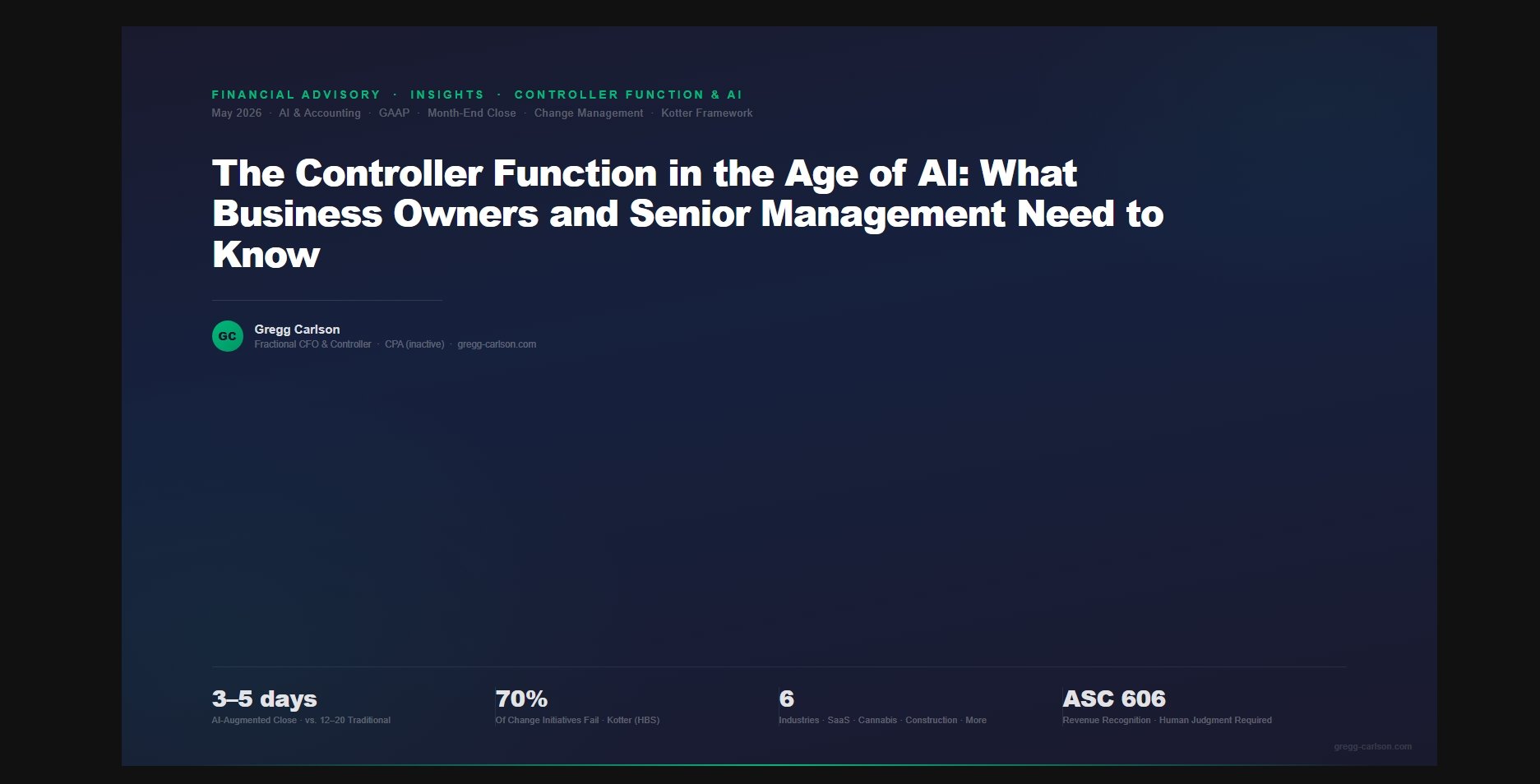
The Controller Function in the Age of AI: What Business Owners and Senior Management Need to Know
The Controller function — month-end close, account reconciliations, financial reporting, GAAP compliance — is the finance role most immediately transformed by AI.
AI automates the mechanical. It does not replace the judgment. Revenue recognition under ASC 606, complex accruals, intercompany eliminations, lease accounting under ASC 842, inventory costing methods, and management reporting context all require professional judgment that no current AI system can reliably provide. A business that replaces its Controller with AI tools alone will produce faster financial statements that are less reliable.
AI at Scale: Three Approaches to Capital Allocation — A Corporate Finance Case Study Using Amazon, Microsoft, and Google
Amazon, Microsoft, and Google are each spending $80B–$200B on AI infrastructure in FY 2026 — a combined commitment approaching $600 billion. But the strategies are fundamentally different: Amazon is building vertically (custom chips + cloud), Microsoft is monetizing through distribution (Azure + Copilot + OpenAI), and Google is leveraging its model advantage (Gemini + Search + Cloud). The capital allocation choices each company makes today will determine their competitive positions for the next decade.
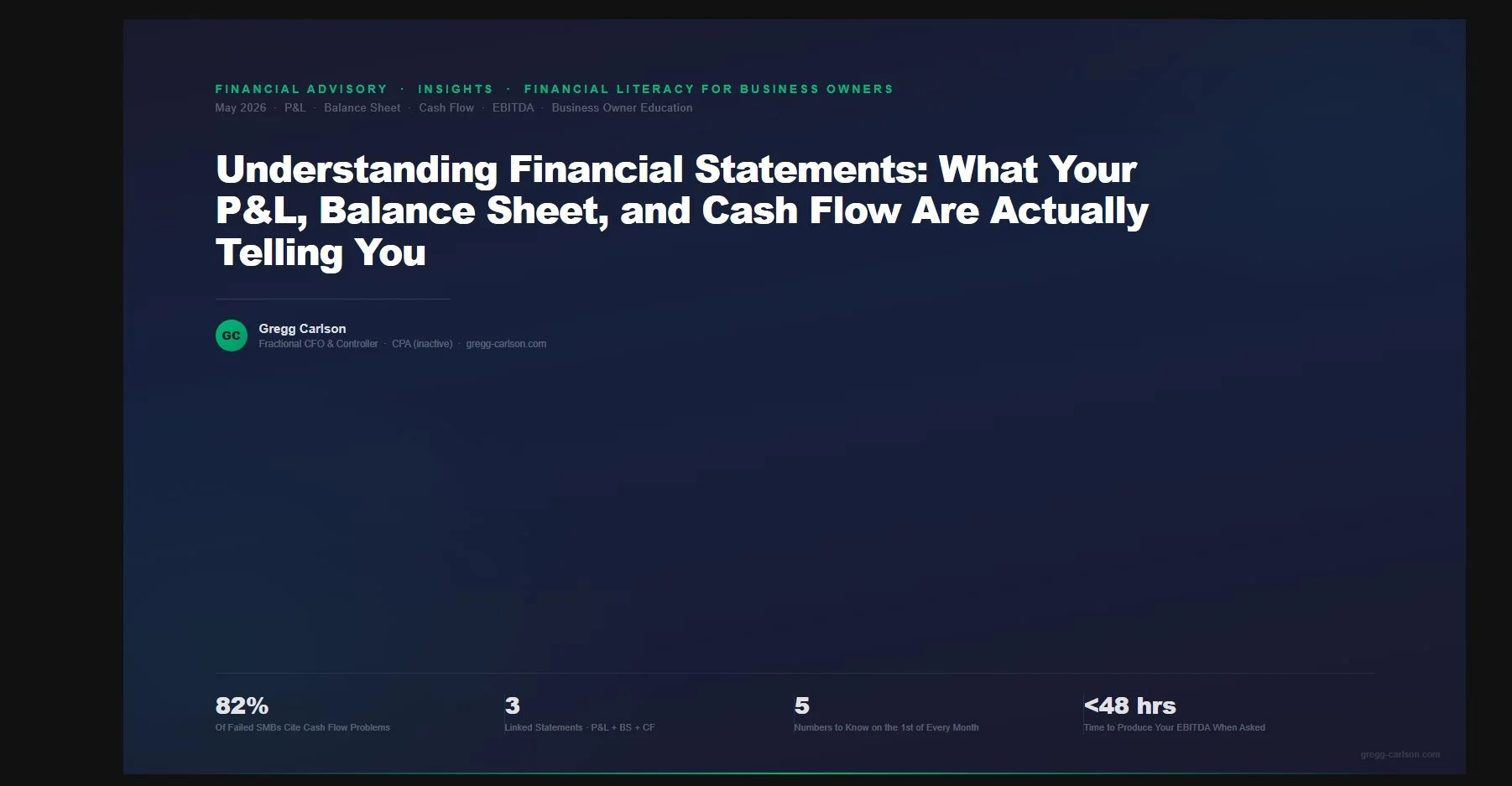
Understanding Financial Statements: What Your P&L, Balance Sheet, and Cash Flow Statement Are Actually Telling You
Most business owners read their financial statements once a year, usually at tax time, after their accountant has already prepared them. The value in financial statements is not in confirming what happened — it is in telling you what is happening right now and what is likely to happen next.
The three financial statements are not three separate documents. They are three views of the same business, linked together. The income statement tells you whether you made money. The balance sheet tells you what you own and owe. The cash flow statement tells you whether you have cash. A business can show profit on the income statement and simultaneously run out of cash.
Amazon (AMZN) Valuation After Q1 2026 Earnings: A Two-Stage DCF Analysis Across Seven Business Segments
Amazon’s Q1 2026 earnings beat across every major line: $181.5B revenue (+17% YoY), $23.9B operating income at a record 13.1% margin, AWS growing 28% to $37.6B (fastest pace in 15 quarters), and Advertising at $17.2B (+24% YoY) crossing $70B in TTM revenue.
Amazon is not one business — it is seven with radically different economics. AWS and Advertising, which represent approximately 31% of revenue, generate the overwhelming majority of economic value. Valuing Amazon without separating these segments produces a meaningless blended average.